


The room where the policy was written
Somewhere in the history of every organisation, there is a room where a policy was written. Legal was in the room. HR led the process. There was time to think it through, and there were second drafts.Twenty-nine years into working at Morrisons, on a Christmas shift, Sean Egan was spat at by a repeat shoplifter. He reacted. That reaction triggered a disciplinary process. The process, followed exactly as written, ended in his dismissal.I've spoken directly to Sean. I tried more than once to reach Morrisons' chief executive, to understand the company's side of this properly, and had no response. I'm not taking a side. What follows is a decision clarity reading of one case: what happens when a policy written in a calm room gets applied to a person who is not in a calm room at all.
Why this matters
A policy is only as good as the conditions it was built to survive. Most organisations writepolicy for the meeting room and then apply it, unmodified, to the shop floor, the ward, thecockpit, wherever the pressure lives.
The number of people affected by a decision grows at every stage it passes through, and almost none of that growth is visible to the people who made the original decision.
Competence at every individual stage of a process is not the same thing as the process producing the right outcome. A system can be followed correctly from end to end and still fail the person it was meant to govern.
The policy that eventually decided Sean's case was written to reduce organisational liability and to create consistency across every store. Both of those are legitimate goals, and the people whowrote it were doing a genuinely difficult job: building one document that had to hold for the board, the chief executive, legal, HR, compliance, insurers, regulators, shareholders, store managers and frontline colleagues, roughly ten stakeholder groups, all with a legitimate claim on what the policy said.
What that room did not, and structurally could not, model was the person who would one day have to execute the policy in real time. The people who write governance documents have information, time, legal support and distance from any specific incident. Their judgement is fully available to them because nothing about writing a policy puts them under threat. This is where the case starts, not with the incident: a failure of what DDR calls Strategic Conviction, a conviction nobody ever stress-tested against the reality it would eventually govern.
The person on the shop floor, spat at during a twelve-hour Christmas shift by someone he already knew as a persistent problem, was not deciding from that same platform. That's not weakness. That's biology: under acute stress, cognitive load rises, working memory narrows, the capacity to weigh several consequences at once shrinks, and emotional response starts to dominate the decision ahead of anything else does.
Most of the commentary on this case has focused on whether Sean's dismissal was fair. There'sa more important question underneath it: was the policy that decided his case ever designed to govern the reality it was applied to? In most organisations, including this one by every visible sign, it was not. And the moment that mattered here wasn't the disciplinary hearing weeks later. It was the second or two after he was spat at, when the situation had already been framed, by policy, by precedent, by habit, as a conduct case rather than a human one, before anyone had the chance to ask whether that frame even fit.
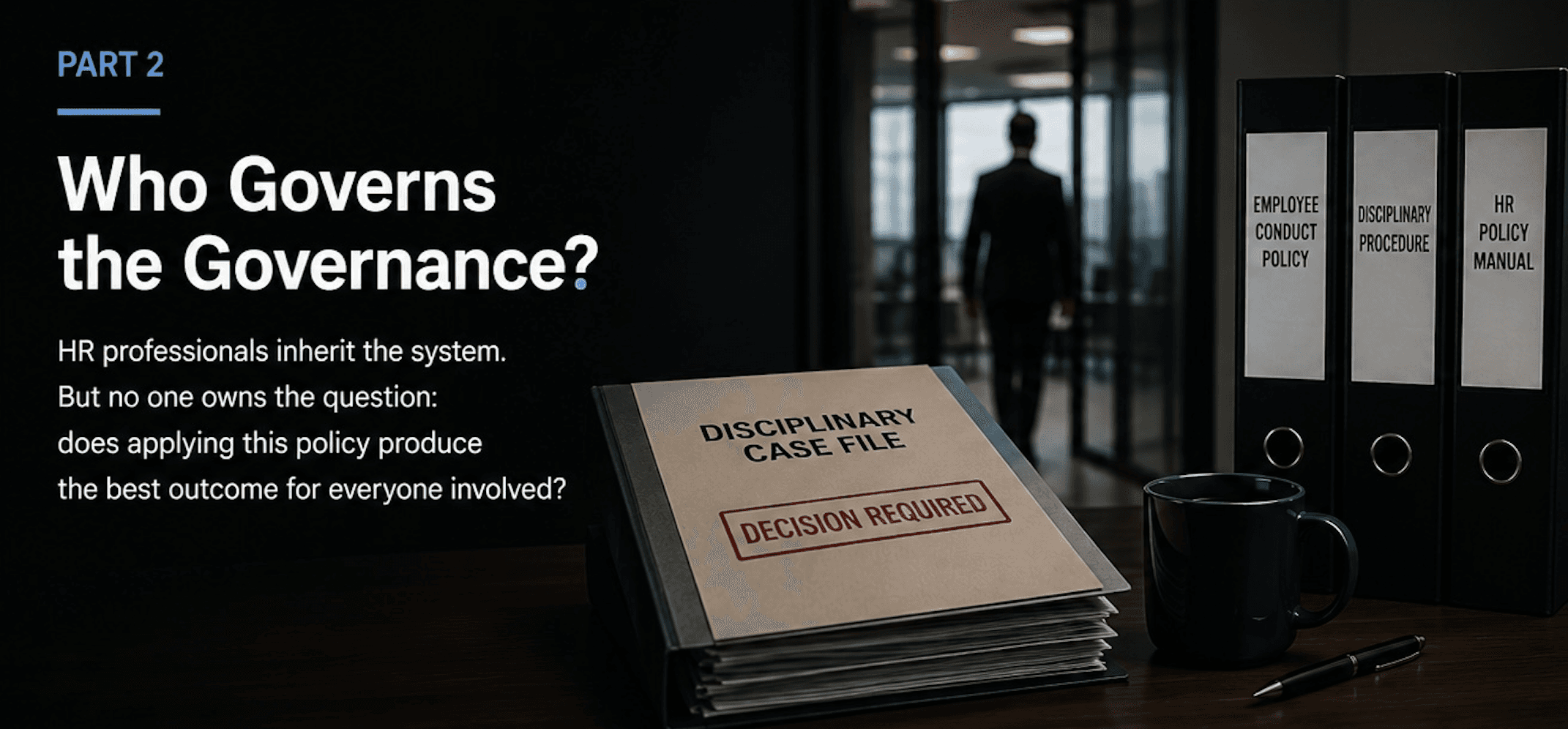
By the time Sean's case reached a formal disciplinary process, the policy already existed, the precedent had already been set, and the legal advice had already been taken. The person running that process was not making it up as they went. They were, by every account, a competent professional doing exactly what the job asked: applying the framework consistently, protecting the organisation from the risk of treating similar cases differently, checking the right boxes in the right order.
Their competence was never really the question. What failed was Decision Posture, the state everyone in that process was deciding from: the framework itself, built to handle a calm-room reality, being applied to a man who had just been spat at after twenty-nine years of service and had reacted the way most people would react under that kind of provocation. Nobody in that process had the standing to ask the one question that would have changed everything: does applying this policy exactly as written produce the right outcome here, for everyone involved, notjust the compliant one? That question needs someone with accountability not just for following the process, but for its consequence. In most organisations, nobody holds that accountability, and this was no exception.
Underneath both of those failures sits a third: Stakeholder Reality, or in this case, the stakeholder map nobody was tracking. At the policy design stage, that map ran to roughly ten groups, all internal, all with a seat in the room where the document was drafted. By the time the disciplinary process concluded, it had grown to seventeen: Sean, his family, his colleagues, regional management, occupational health, employee representatives, the disciplinary panel, the appeal panel, future candidates weighing up how long service gets treated here, and existing staff watching what happens when someone gives twenty-nine years and has one bad day. By the time the story reached national press, LinkedIn and parliamentary comment, the number of groups with a legitimate stake had passed thirty: national media, social platforms, MPs, trade unions, industry commentators, customers deciding whether to keep shopping there, staff and recruits running the same calculation, mental health advocates, competitors watching closely, investors reading the reputational signal.
None of those later groups were in the room when the policy was written. None of them featuredin the thinking at the point the disciplinary decision was made. They arrived afterwards, becausefailures like this compound: every stage a decision passes through widens who it touches, and the cost of fixing it rises with each stage. A policy can be redesigned; that costs time, but it's recoverable. A disciplinary outcome can be appealed; that carries cost, but it's bounded. A national story, with MPs and trade unions and a social media reaction attached to it, produces reputational, commercial and human costs that nobody modelled at any earlier stage, because nobody at any earlier stage was ever asked to model them.
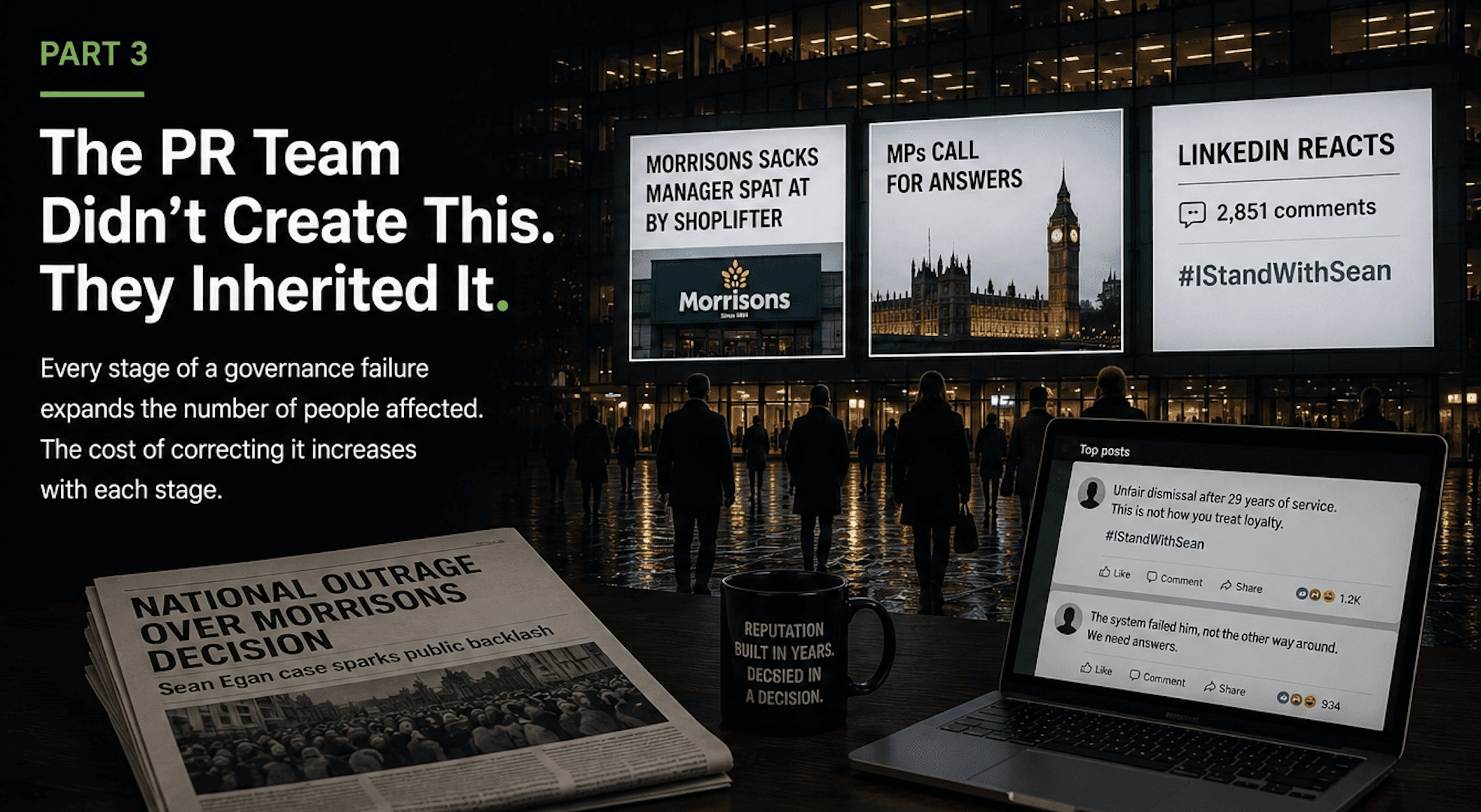
Communications teams do not create the crises they're handed. They inherit them, usually late, usually with a fraction of the picture and a shrinking set of options, because the longer a failure has been running before it reaches them, the fewer options are left by the time it does. That's where Execution Integrity broke down, the last of the four, and the one that should have caught what the other three missed. A disciplinary process finished. An appeal ran its course. A news cycle moved on. But the gap that produced all three, nobody holding accountability for asking whether the system itself was producing the right outcome, not simply the defensible one, was never named, and as far as the public record shows, was never fixed.
What was learned, and what wasn't
What Morrisons learned, if the public record is any guide, is how to run a disciplinary process correctly and how to manage a crisis once it arrives. Both, by most accounts, were handled competently at the stage each was handled.What wasn't learned, because nobody at any stage had the job of asking it, is the question underneath all four stages of the cycle at once: a Strategic Conviction never stress-tested against the reality it would govern, a Decision Posture nobody had access to when it counted most, a Stakeholder Reality nobody was tracking until it had already grown past the point of managing, and an Execution Integrity that closed the loop at every individual stage, disciplinary, appeal, news cycle, without ever closing it on the one thing that caused all three. That's a governance design failure, not an HR one, and it will produce the same outcome again, for someone else, until an organisation decides to stress-test its policies against the reality they'll be executed in, not just the legal standard they were written to meet.
How this carries forward
Before a policy goes live, ask what decision window the person executing it will have under pressure: seconds, not the hours the policy took to draft.
Map the stakeholder reality of who is affected by a decision at the point it's made, not at the point it becomes visible. The map is always larger than it looks at the design stage.
Give someone explicit ownership of the question a compliant process can still miss: is this producing the right outcome, or just the defensible one?
The cost of finding a governance gap late is always higher than the cost of finding it first.
If any of this sounds like your organisation, before the story ever reaches a headline, that's a conversation worth having early.


