


The Dam That Never Cracked
Vajont Dam, Italy. 9 October 1963.
On the evening of 9 October 1963, the man running the Vajont dam site wrote to his director asking him to cut short his holiday. The mountain above the reservoir was moving faster than it ever had, he said, the cracks on the road were widening by the hour, and the trees on the upperslope were leaning further each time anyone looked. He closed the letter with a line that was notan engineering judgement at all: "May God bless us all." Within hours, 260 million cubic metres of that mountain broke away as a single mass and dropped into the reservoir below. The dam did not move. Almost everyone downstream did not survive.
Why this matters
The Vajont dam itself performed exactly as designed. The failure that killed close to two thousand people happened entirely upstream of the concrete, in the decisions that let a known risk keep being managed rather than acted on.
The warnings that could have prevented the disaster were not missing. They existed in signed reports, private letters, court testimony and a mayor's telegrams, sent by differentpeople, in different roles, across more than three decades.
What both the engineering record and the criminal trial that followed established, and what they left unexamined, is still the more useful question for anyone responsible for a decision under sustained commercial pressure.
The commitment
The Vajont reservoir was the idea of Società Adriatica di Elettricità, SADE, the private utility that held the electricity monopoly across north-eastern Italy. Its founder, Giuseppe Volpi di Misurata, had previously served as Italy's finance minister; by the 1950s the company's reach into government approval processes was close to total. The original 1943 authorisation was for a dam roughly 200 metres high. In 1957, with construction already under way, SADE sought and received approval to raise it to 266 metres and more than treble the planned capacity of the reservoir. That single decision set the terms for everything that followed. It was a strategic conviction in every sense, made once, at the top, and never revisited even as the ground it rested on kept shifting: a very large amount of capital, reputation and institutional standing was now resting on a valley whose geology had already been flagged, in reports going back to 1928, as prone to landslides.
Within weeks of that 1957 approval, the correspondence between the dam's designer, Carlo Semenza, and the state's consulting geologist, Giorgio Dal Piaz, shows the two men drafting the reassuring language of Dal Piaz's own supposedly independent report together, with Semenza supplying the wording and Dal Piaz signing it. It is a small detail, but it marks the point at which the project's decision posture changed: from testing whether the valley was safe to producing the paperwork that said it was.
The warnings
Over the next six years, at least five people in five different positions reached the same conclusion the company's official position denied.
Leopold Müller, an Austrian rock mechanics consultant retained twice by SADE, estimated in 1961 that the unstable mass above the reservoir ran to 200 million cubic metres and concluded there was no practical way to stop it once the water rose further. That report was never forwarded to the regulator.
Edoardo Semenza, the designer's own son, carried out an independent geological study the same year and arrived at a similar figure, 250 million cubic metres. Before the study went anywhere official, his father asked him to show it privately to Dal Piaz first, so that anything requiring "softening", his words, could be softened. It also never reached the control authority.
Tina Merlin, a journalist, reported in 1959 that the reservoir put the valley's population at risk. The company took her to court for spreading false and alarming news. She was cleared. The court found nothing in her reporting exaggerated.
The commission responsible for testing the dam's safety toured the site in 1961 by way of Cortina and Venice; one of its own engineers later admitted under questioning that he remembered the visit mainly for the sightseeing, lunches and dinners, and filed his report on notes the company supplied afterwards.
None of these five people worked for the same employer throughout the period. SADE itself wasnationalised into the state utility ENEL in the months before the disaster. The pattern that ran through every one of these warnings, arrive, get reframed as manageable, and lose its urgency by the time the next one appears, survived every change of personnel and every change of ownership. That persistence is what a single bad actor cannot explain, and what geology was never built to address either. It sits in the stakeholder reality the project kept failing to register: the people closest to the mountain, the villagers who watched animals leave the slopes, the mayor of Erto-Casso who cabled the company twice in the final month and was answered neither time, consistently saw the danger most clearly and were heard least.
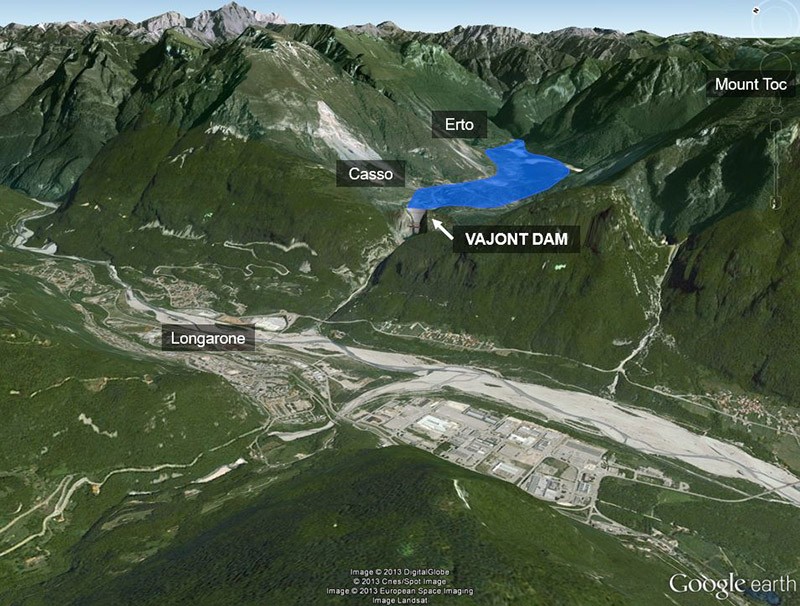
The final week
By September 1963, the slope was moving at a rate that had gone from one centimetre a day to twenty centimetres a day to, in the last week, whole metres. On 26 September, the company began lowering the reservoir. It was, by any earlier standard, the right call. It came after the movement had already outrun the model tests used to justify how full the reservoir could safely be kept, tests that had been run using gravel and wooden planks to approximate a mountainside, and whose own findings on safe water levels were quietly exceeded weeks earlier. On 9 October, the site director's letter asking his superior to come back from holiday was the last written record before the collapse. Execution integrity in those final seventy-two hours was not the failure. The failure was already three decades old by the time execution was all that was left to manage.
The slide itself took under a minute. The wave it created went roughly two hundred metres over the crest of the dam and down the valley toward the town of Longarone. The official death toll stands at 1,917.
What was learned, and what wasn't
The geological case that followed is still taught in engineering courses. It traced the collapse to bedding planes, groundwater pressure and rock mechanics inside Monte Toc, and it produced a lasting, useful conclusion: reservoir projects need continuous geological monitoring, not a one-off assessment before construction begins. That lesson has held.
The criminal trial that followed took nearly eight years to conclude. Of eleven men charged, two were convicted, for the narrow offence of failing to warn residents and order an evacuation in the final days before the collapse. The first instance court declined to find the landslide itself predictable. Both records, the geological and the judicial, answered the question they were built to answer. Neither asked why five people, in five different positions, reached the same true conclusion, decades apart from one another, and still watched their warnings fail to reach a decision before it was too late. That is not a question rock mechanics can answer, and it is not one a manslaughter charge is designed to ask. It is a question about whether the structure around a decision maker lets true information reach them while there is still time to use it, and Vajont has never really been asked to answer it.
The dam still stands. It has stood, untouched, through every winter since 1963, doing exactly the job its engineers built it to do. The valley beneath it emptied for a different reason: the people who could see what was coming were, at every stage, not asked, not believed, or asked to write it more gently. Sixty years of study have explained the mountain. What moved the waterpast the men who could have stopped it in time is still the harder question, and it is not one either verdict was built to answer.
How this carries forward
A decision made early, under pressure to justify a large prior commitment, can quietly become the frame every later signal has to fit, regardless of who is in the room by the time the warnings arrive.
Technical accuracy in a warning is not the same as that warning reaching someone ableto act on it. The gap between the two is organisational, not scientific, and it is where most of the damage at Vajont was done.
The people with the least formal authority over a decision are often the ones closest to its consequences. Vajont's mayor and its one convicted journalist were both right, years apart, and neither had the standing to make that fact land in time.
If this pattern is recognisable in your own organisation's history, glad to continue the conversation.


