

Lester Clark

A key decision reading of Moby-Dick: where judgement held, where it broke, and what it shows about deciding under pressure.
Before this review
This is the first book taken through the decision clarity lens: four independent tests put to every decision below, the same four we'd put to a real boardroom, was the conviction genuinely reasoned or borrowed, did the account stay honest as pressure built, was the truth shared with those who had to live with it, and did the decision survive contact with the moment it had to be acted on. Worth knowing before the case opens: the book's own history is a decision clarity story in miniature, under 4,000 copies sold in Melville's lifetime, dismissed by the reviewers who noticed it at all, and not read as anything more than an adventure story for roughly seventy years.
Summary
Moby-Dick is usually read as a story about obsession. Read as a study in decision clarity, it is something narrower: moments in which a group of capable people either fail to convert an accurate account into action, never frame the moment as requiring a decision at all, or make a decision so fast and so consistently that nobody ever asks whether it should have gone differently. By the end, only one of them is left to carry any of it forward.
What this review shows:
A commitment secured through staged ritual is not the same as a commitment tested by the people asked to keep it. The one man who does test it, correctly, gets a different question answered instead of his own, and never gets a second chance to ask it.
A better alternative that is named and never tried is not the same as one that was properly weighed. Starbuck reasons his own way to the right call, then talks himself out of testing it, in the same breath he reasoned it through.
The same small scene can hold one decision that was probably right and one that wasn't, and telling them apart matters. A whaleboat crew makes a fast, sound call under real pressure, then a slower, costlier one minutes later by refusing to look again at what was actually happening.
Seven men can look at the same object and reach seven different meanings, and if nobody frames it as a decision, nothing follows from any of the seven readings, however sharp each one is on its own.
A settled truth and a change of heart do not usually come apart this cleanly unless the coming-apart is doing some work. Ahab reaches the fullest, most honest account of his own life in the whole book, unprompted, and reaches for fate instead of turning the ship only once turning the ship becomes a real, immediate choice.
Decisions at a glance
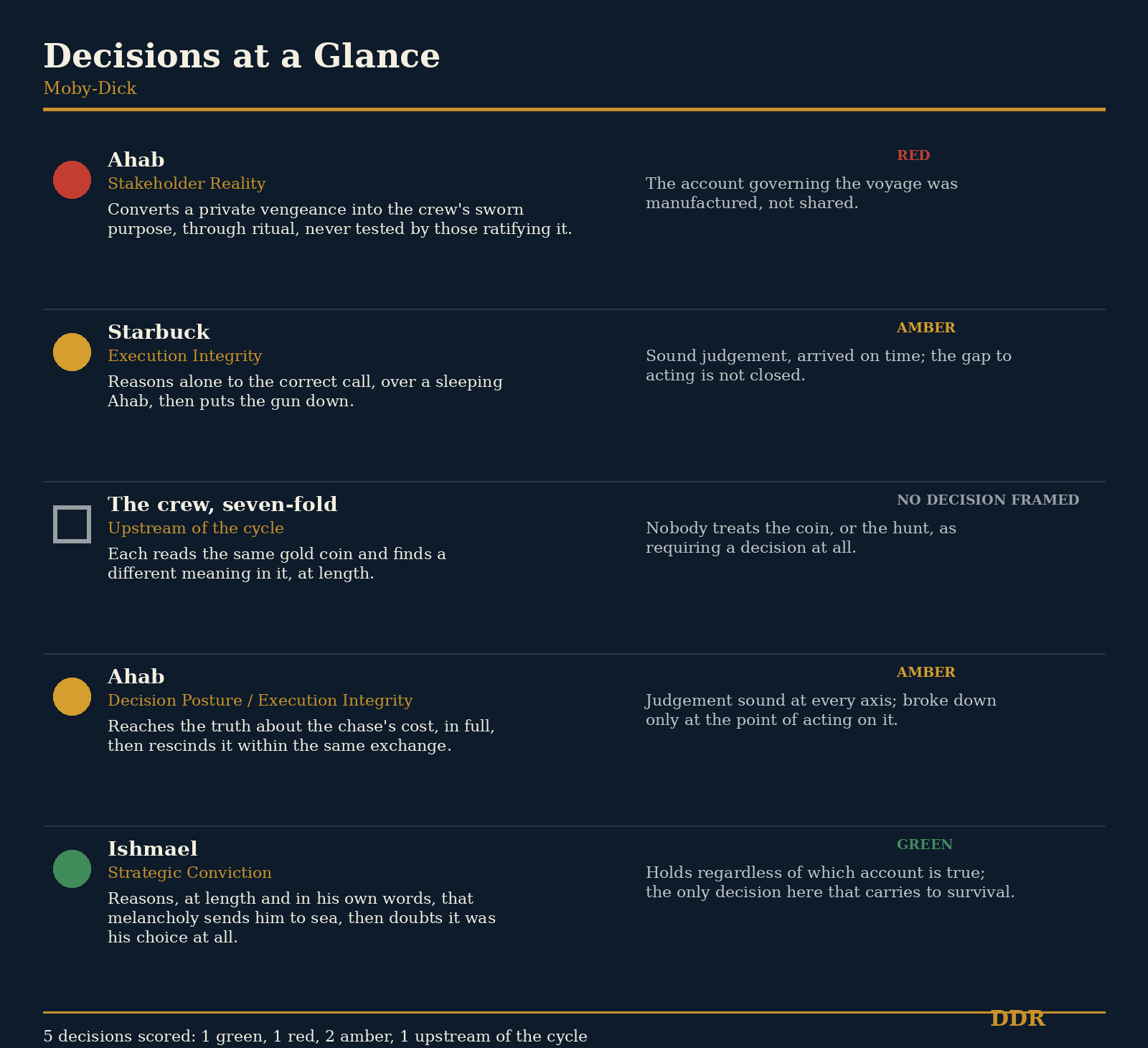
RAG legend:
Green: the decision followed the relevant component soundly.
Amber: sound at one or more components, broke down at another; this includes a decision that reaches full alignment and is then rescinded before execution, since judgement held and only the conversion to action broke down.
Red: the account, the commitment, or the execution was compromised at the component named. Upstream of the cycle: no decision was ever framed, so no component applies.
The review
A vow nobody tested
A man loses a leg to a whale, and spends the rest of the voyage treating every fact that follows as confirmation of what he had already decided the whale meant.
Herman Melville spends the book's first third establishing, in careful, patient detail, what a whale actually is. Ahab's whale is not that animal. Somewhere between losing his leg and putting to sea again, he stopped treating Moby Dick as a whale and started treating it as a will. Before this reaches the rest of the ship, he tests it on one person. He summons the entire crew aft and delivers the speech he is still most quoted for: all visible objects are pasteboard masks, and if a man is going to strike at all, he should strike through the mask at the reasoning thing behind it. Only one man on that deck tests it while it is still being said. Starbuck answers him directly: "I came here to hunt whales, not my commander's vengeance. How many barrels will thy vengeance yield thee even if thou gettest it, Captain Ahab?" It is the single clearest, most accurately stated objection anyone raises in the entire book. Ahab never answers it. He answers a different question instead, an economic challenge met with a claim about masks and the reasoning thing behind them, and the ritual is already in motion before Starbuck can bring him back to the one he actually asked. The crew drinks an oath to a whale most of them have never seen. Starbuck drinks it too, in what the book calls "enchanted, tacit acquiescence," and by the time the goblet reaches him a second time, the question he raised minutes earlier, and never got an answer to, has nowhere left to go.
What makes this instructive rather than simply sad is how little it resembles confusion from the outside. Ahab is not muddled, and he is not a fool. His officers do not doubt his skill for a moment. What Starbuck stops trusting is not Ahab's competence but his account of reality, and by the time the gap between the two becomes visible, that account has already been governing the ship for months.
Two decisions, seven readings
Not every decision on this ship takes months to unravel. Some take seconds, and this book actually contains two decisions in the same small scene, not one, and they deserve to be told apart. Pip, the ship's cabin boy, is put into Stubb's boat crew as a stand-in oarsman. A struck whale rocks the boat and Pip jumps overboard in fright, tangling himself in the running line. The harpooneer Tashtego has a knife over the rope and one question for Stubb: "Cut?" Stubb answers in three words: "Damn him, cut!" The whale is lost. Pip is saved. That first decision, made in under a second with a man's life and a valuable catch both live at once, is close to the only clean piece of fast, high-pressure judgement in the whole book. It is hard to see what a slower, more deliberate captain could have done better in that instant.
Afterward, Stubb gives Pip the plainest warning in the book: "Stick to the boat, Pip, or by the Lord, I won't pick you up if you jump; mind that. We can't afford to lose whales by the likes of you; a whale would sell for thirty times what you would, Pip, in Alabama." It is callous, and it is also completely honest. Stubb has told Pip exactly what will happen, and exactly why. The second decision comes later, when Pip jumps again, and this is the one that actually costs something. Stubb keeps his earlier word rather than looking freshly at what is happening in front of him now: "Stubb's inexorable back was turned upon him," and the boat gives chase to the whale instead of turning back. Pip is left alone in the middle of the ocean until the ship, by "the merest chance," finds him. From that hour, "the little negro went about the deck an idiot." Melville is careful not to let the reader condemn Stubb outright, "the thing is common in that fishery," he writes, but the cost is stated plainly all the same: a man's mind, for holding to a threat instead of reopening the question of what to do, the second time it actually happened. It is also the reason Pip is on the deck at all, mute and altered, when he comes to read a coin later and can only give it back a line from a grammar book.
That scene comes soon after. Ahab has nailed a gold coin to the mast as a bounty for the white whale, and one morning he stops and reads himself into it: the peaks stamped on it are Ahab, the volcano is Ahab, the coin is the whole rounder globe mirroring back his own mysterious self. Starbuck reads it next as scripture, and quits it quickly, "lest Truth shake me falsely." Stubb reads it as a joke about the zodiac and the life of man. Flask reads it as sixteen dollars and nine hundred and sixty cigars. The old Manxman reads it as witchcraft. Queequeg cannot place it. Fedallah bows to the sun stamped on its face and says nothing. And then Pip comes to read it last, the same Pip who was left to the ocean for a whale's sake, and all he can produce is a line out of a grammar book: "I look, you look, he looks; we look, ye look, they look." Seven readings of the same object, and not one of the seven people standing at that mast ever frames the coin, or the hunt it represents, as something requiring a decision. This is not a failure anyone can be blamed for in the way Ahab's ritual can. It is the quieter, and in some ways more sobering, finding: a ship can spend an entire chapter looking directly at the thing that will kill it, and calling that looking, and never once call it a decision.
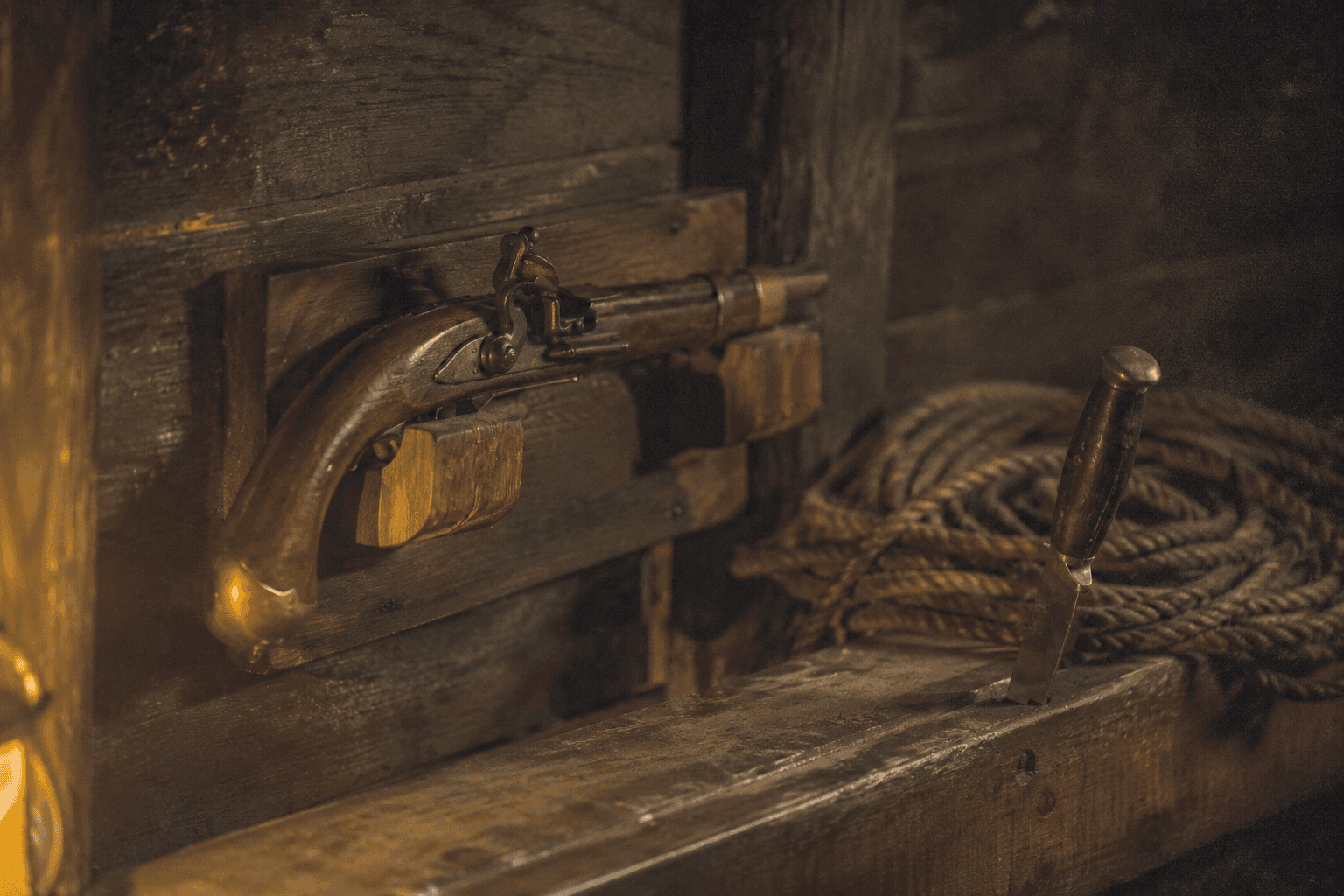
Starbuck sees the ritual for what it is early, and says so plainly, which turns out not to be the hard part. The hard part comes late, in the chapter Melville titles simply "The Musket." Starbuck is alone in Ahab's cabin at night. The loaded gun in the rack is the same one Ahab once pointed at him. He reasons his way, in full, out loud to himself, to the conclusion that this may be the only way left to save the men under his command. Then he asks himself the one question that actually mattered: "is there no other way? no lawful way?" And he answers it himself, in the same breath, with a single line, only a fool would try confining Ahab instead. He never actually tests that alternative. He does not wake Stubb, or Flask, to work through it together, though minutes later he sends Stubb belowdecks for something that matters far less, to tell Ahab the wind has turned fair.
He puts the gun down.
It is not a failure of nerve. Starbuck is not a coward anywhere else in this book. What happens to him is narrower, and considerably more common than cowardice: he builds his own better alternative and discards it in the same breath he built it in, without ever putting it to the one test that might have told him whether it would actually have worked. The judgement is sound, the moment is real, the means and the standing to act on it are both in his hands, and the alternative that might have changed everything is named and dropped before it is ever tried. He returns to his post.
The truth spoken, and taken back
The clearest instance of all comes later still, in the chapter called "The Symphony," on a calm day near the end of the voyage. Ahab is at the rail, weeping, unprompted. Starbuck approaches. What follows is the most reality-led passage Ahab has anywhere in this book: an unbroken, first-person reckoning of forty years at sea, in which he names the marriage he "widowed" by sailing the day after his wedding, and calls himself, in his own words, "a forty years' fool—fool—old fool, has old Ahab been." For one continuous passage, Ahab reaches every test a stated position can be put to, and states a conclusion entirely on his own, before anyone has asked him to: "why this strife of the chase? why weary, and palsy the arm at the oar, and the iron, and the lance? how the richer or better is Ahab now?" It is, by any plain reading, the answer to everything this review has traced so far.
Nothing changes about the whale, or the risk, or the voyage, between that admission and what happens next. What changes is that Starbuck, for the only time in the book, puts a real way home on the table, right there, this instant: "this instant let me alter the course!" It is exactly then, not before, not while Ahab was still merely reckoning to himself, that his glance "averted," and he reframes the whole preceding account: "Is Ahab, Ahab? Is it I, God, or who, that lifts this arm? ... Fate is the handspike." The offer to turn home lapses. Nobody argues him out of his own conclusion. He argues himself out of it, and the argument he reaches for, that some force beyond him and not his own judgement is what moves his arm, arrives only once turning back has stopped being a hypothetical and started being a real, immediate choice. Starbuck's answer is not recorded in words. He is described, in the same chapter, as having "blanched to a corpse's hue with despair" and stolen away, which is as close as the book comes to showing what it costs to watch someone see the truth clearly, and then reach for a reason to take it back exactly when acting on it would have meant something.
Read together, these are not different failures to see clearly. Ahab converts his own certainty into the crew's sworn purpose and answers the one real challenge to it with a different question entirely. Stubb makes one fast, sound call under real pressure and one slow, costly refusal to look again, in the same afternoon. A whole crew looks at the clearest possible symbol of what is happening to them and never once calls it a decision. Starbuck builds his own better alternative, twice, in two different chapters, and drops each one before testing it. And Ahab, alone among everyone in this book, reaches the fullest, most honestly stated account of what the chase has actually cost him, and reaches for fate instead of the wheel in the same breath a real way home is put in front of him. None of the people in this book is confused about reality at the moment that matters most. What breaks, every time, sits downstream of that clarity, gets no chance to be tested at all, or never gets far enough to be called clarity or its absence in the first place. They are one failure, in different settings, and it has a shape that repeats: whatever is going to interfere with a decision is usually already present before the decision point itself, a mood, a momentum, a ritual already running, and whatever gets offered afterward as the reason, a metaphysic, a threat kept, a claim about fate, arrives second, and does the work of making the decision feel settled rather than the work of actually testing it.
There is a reason a correctly stated account and a change in what a person then does can pull apart this cleanly. In cognitive psychology, naming a truth accurately and converting that naming into action are treated as separate processes, governed by different pressures, not two stages of the same one. Insight does not reliably purchase follow-through. Ahab's reversal happens in the time it takes to look away.
Ahab dies with the ship three chapters later. Starbuck goes down with it. So does Stubb, so does Flask, so does the entire crew who drank the oath at the mast, and so does the boy who could only read a coin by reciting a grammar lesson back to it. Of everyone whose decisions this review has traced, exactly one man comes up out of the water afterward, and his is the one decision in the whole book that this review can score green. Ishmael tells the reader plainly, at the very start, what sends him to sea: a recurring melancholy, "a damp, drizzly November in my soul," bad enough that it takes "a strong moral principle" to keep him from violence in the street, and shipping out is his own "substitute for pistol and ball." It is a reasoned account, given at length, in his own words. Then, in the same chapter, he doubts it himself: he calls his own sense of free choice a possible "delusion," and credits "the invisible police officer of the Fates" instead. Every other reversal in this book arrives once acting on the truth would actually cost something. Ishmael's low mood is on the page from the first paragraph, in full, and nothing about it corrupts what he does next; it does not get reframed into an excuse once a cheaper alternative appears, because there is no cheaper alternative on offer, only the sea, which he takes. He never resolves whether his account is reasoned or fated, and it does not matter to what he does next; he goes, and does not reverse it. It carries no staged ritual, no manufactured consent, no truth spoken and then reversed, and no thirty-times-your-worth arithmetic, and it is the only decision anyone in this book is allowed to simply see through, end to end, to survival. He survives by nothing he did in the water: a coffin built for another man, a ship that was out looking for somebody else's lost crew entirely.
The cycle does not close for anyone still aboard when the ship goes down. It closes, if it closes at all, only in the one man left to carry it forward. Whatever ship takes him next, he boards it having watched a private vengeance become everyone's sworn purpose unchallenged, a sound fast call and a costly slow refusal happen minutes apart in the same boat, seven men read the same coin seven different ways with nobody troubling to call it a decision, a mate build his own way out of two separate disasters and test neither one, and a captain state the plainest truth he ever spoke and reach for fate instead of the wheel the moment turning it became real. He carries all of it onto whichever deck he next stands on. Nobody else aboard the Pequod gets to.
The wreck belonged to no one man aboard the Pequod.
If that gap, between what a capable person or a capable team knows and what they can act on in time, is one you recognise from a room you have sat in, it is worth a direct conversation about decision clarity.
Built through AI with DDR's governed process. Research, drafting, and fact-structuring are AI-assisted. Every factual claim is checked against its source before it's used. The judgement, the checks, and the argument are mine. I take ownership of all of it. Before anything goes out, I read it in full, slowly, System 2 engaged, not skimmed, checking it says what I actually mean, not just what reads well. If a piece can't survive that check, it doesn't go out.


