


Italy: The 50th Anniversary
10 July 1976 — 10 July 2026
Why This Matters
A sequence of individually small decisions — each one tolerated, each one narrowing the margin — can remove the safety buffer of an entire system before anyone registers that it has gone.
When an organisation’s account of its own risk drifts from the actual risk, that gap is almost never visible from inside. It becomes visible when something fails.
The decisions that expand a disaster are often made after the event, not during it. Who holds the information, who receives it, and when, determines whether the harm is contained or compounded.
The Last Entry in the Log
At 6.00 on the morning of Saturday 10 July 1976, the night shift at the ICMESA chemical plant in Meda, northern Italy, signed off and went home.
The production run they left behind was incomplete. The plant’s own operating procedure required the solvent distillation to reach 50 per cent recovery before the reactor could be safely shut down. The operator had managed 15 per cent. He stopped anyway, switched off the agitator, turned off the temperature recorder, and left the building.
The reactor was at 158 degrees Celsius. Nobody on site would be watching it over the weekend.
Six and a half hours later, at 12.37, the bursting disc ruptured. A cloud containing dioxind is charged into the atmosphere above a densely populated farming area between Milan and Lake Como. The cloud drifted south-west on a 4-metre-per-second wind, settling over the towns of Seveso, Meda, Cesano Maderno and Desio.
By the following morning, small animals were dying in gardens. Children were developing skin burns. Vegetation was scorched. The plant managers told the local authorities that a herbicide cloud, likely to damage crops, had been released. They said nothing about dioxin.
The people of four towns continued eating vegetables from their gardens for the next two weeks.
What the Record Shows
The technical literature available to Givaudan, ICMESA’s Swiss parent company, was not silent on what could happen inside a TCP reactor under these conditions. Research published in 1971had described precisely the exothermic reaction sequence that could occur when ethyleneglycol and caustic soda were left in contact with residual heat: an uncontrolled temperature spike to 410 degrees, large-scale gas release. The Italian parliamentary commission that investigated the disaster later confirmed that the plant’s technical manager and production coordinator had read this research before 10 July.
The process at ICMESA had also been modified from the original Givaudan patent in ways that raised the risk. The concentration of caustic soda had been increased, the distillation sequence reversed, and the contact time between the reactive components extended. These changes reduced costs. They also moved the process closer to the conditions under which a runaway reaction was more likely.
None of it had been communicated to the safety authorities. The reactor had no automatic temperature alarm. Cooling could only be started manually. There was no containment vessel to catch the discharge if the bursting disc failed.
This is where Strategic Conviction was set. The operating model had accumulated through cost-reduction decisions, each individually defensible, none collectively reviewed. The safety architecture that existed was designed for the process as originally specified, not for the process as it was running. Nobody had asked whether the two were still the same.
The Frame That Closed Too Early
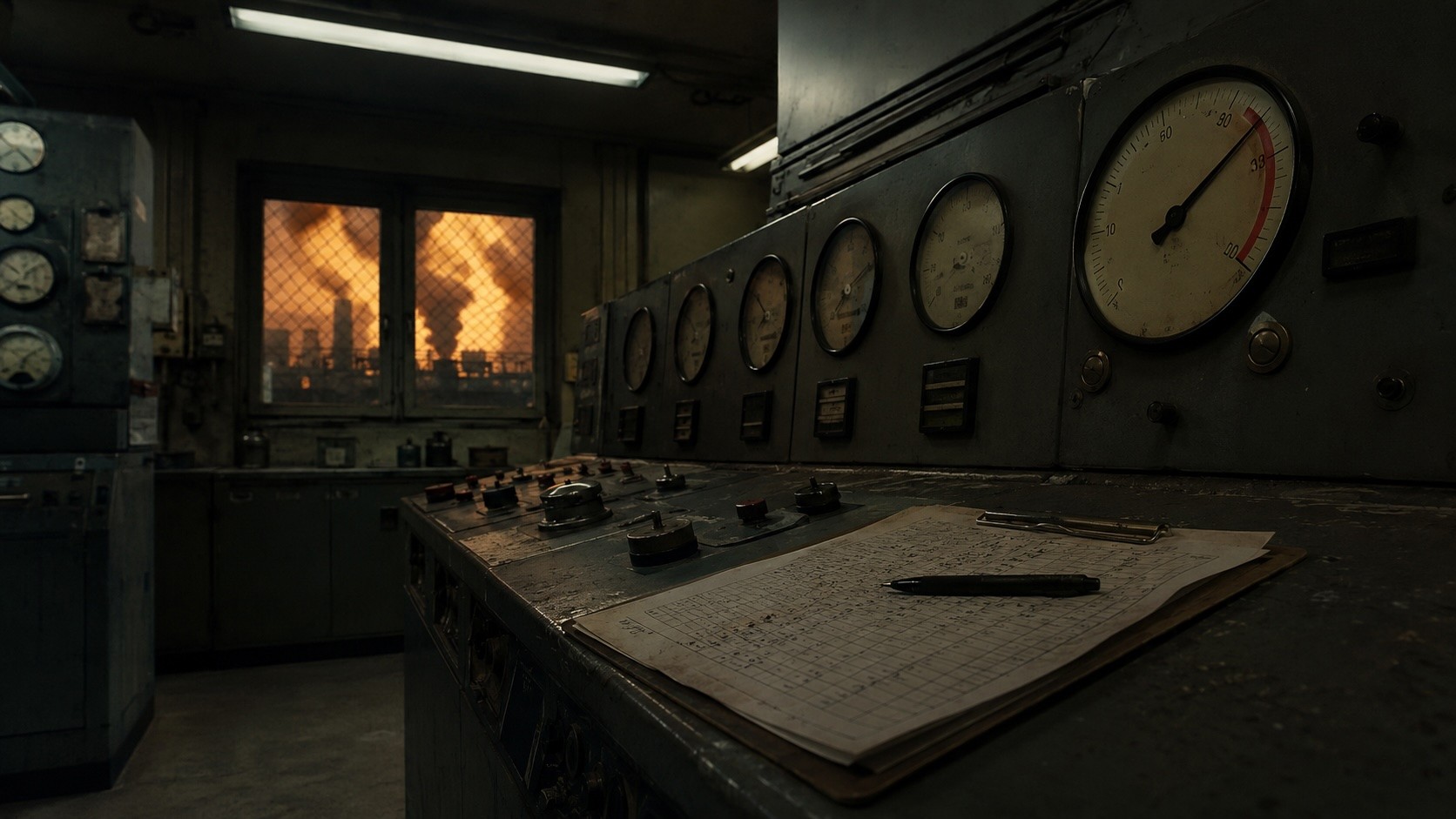
The accident on 10 July was not the product of a single catastrophic error. It was the product of a sequence: the batch started ten hours late on the evening of 9 July; the distillation was abandoned when the shift ended rather than when the procedure required; the agitator was switched off with the reactor still hot; the temperature recorder was disabled; no cooling water was left running; no one was assigned to monitor the vessel.
Each of these was a decision. Each decision narrowed the margin. None of them, individually, appeared to be the one that would matter.
The operators had run incomplete distillation cycles before. Nothing had happened. The conclusion that accumulated, quietly and without any deliberate assessment, was that the situation was readable and manageable. The reactor was within what felt like normal range.They would restart on Monday.
The question that would have changed the outcome was: what will this reactor do for the next thirty-six hours without any human intervention, with residual heat in the coil, the agitator off, and the solvent incompletely removed? That question was not asked. Not because it was unanswerable. The 1971 research had answered it. The answer had not reached the people making the operational decision at 6.00 on Saturday morning.
The frame had closed before the evidence was complete. Decision Posture at the floor level was set on the assumption that the margin was greater than it was. There was no mechanism to test whether that assumption held.
The Ten Days
On Thursday 15 July 1976, five days after the explosion, the laboratory at Givaudan’s facility in Dübendorf, Switzerland, confirmed what the samples from Meda contained: dioxin, in significant concentration.
Givaudan informed nobody outside the company.They sent more samples. They waited for reconfirmation. On Tuesday 20 July, ten days after the release, they finally notified the Italian authorities. By that point, 736 people had been living inside the most contaminated zone. Children had been playing in the fields. Families had been eating from their gardens. Doctors had been treating patients for conditions they could not diagnose, because no one had told them what their patients had been exposed to.
Who Held the Information, and Who Did Not
The decision to withhold the dioxin finding was not made once. It was made every morning for five days.
The stated reason, confirmed in subsequent investigations, was concern about unnecessary panic. The company wanted to verify the quantity and extent of contamination before making any public statement.
This is a recognisable framing. It has the shape of responsibility: careful, measured, deliberate.The question it does not ask is what harm is accumulating in the absence of that information .Every day the population in the contaminated zones continued their normal lives, their exposure increased. The harm the company was trying to avoid, public alarm, was smaller than the harm already building.
The assessment had been fixed on one variable: the company’s credibility and the management of disclosure timing. The other side of the equation, what was happening to the people outside the fence while the verification ran, was not in the frame.
Stakeholder Reality had collapsed entirely. The mayors of Seveso and Meda had been told about a herbicide cloud. The local medical authorities had no toxicological information. The population had been warned not to eat their vegetables, but not told why in terms that would have communicated the actual level of risk. The difference between ‘herbicide’ and ‘dioxin’ is nota matter of degree. It is the information on which every subsequent decision by every affected family depended.
Meanwhile, on Monday 12 July, the first health symptoms appeared. On Tuesday 13 July, small animals were dying across the neighbourhood. On Wednesday 14 July, skin burns appeared on children. On Thursday 15 July, the day Givaudan had the laboratory confirmation, 18 local children were admitted to hospital. The doctors treating them had no idea what they were treating.
The laboratory result sat in Dübendorf. The children sat in hospital.
What Happened When the Information Finally Arrived
When the full picture reached the authorities, the response was substantial. The Italian government committed major funding. Lombardy Region created a special bureau staffed by up to 100 people. Epidemiological monitoring was established for 220,000 people. Evacuation of the most contaminated zone began. Livestock was slaughtered to prevent dioxin entering the food chain. Decontamination work ran for five years.
The site that caused the disaster is now a park. The contaminated soil was sealed in two enormous concrete-lined basins beneath it. The former factory site is now a sports complex.
Roche, the ultimate parent company, paid over 300 million Swiss francs in compensation to individuals, businesses, local authorities, and regional government. Five former ICMESA and Givaudan employees were convicted of causing the accident through negligence.
On 24 June 1982, the European Council adopted the Seveso Directive, the most significant industrial safety legislation in European history. It established, for the first time, the legal requirement that operators of hazardous industrial sites must inform the public and the relevant authorities about the nature of the risks they face, not simply that risks exist. The directive has been updated twice and remains in force across Europe today, as the Seveso III Directive.
Execution Integrity, in the end, was forced by law. The mechanism that should have transmitted the real risk picture outward, before the event and in the days after it, was absent. Legislation built the structure that organisations had not built for themselves.
What Was Learned, and What Was Not
The Seveso case contains two distinct failure sequences, and they are worth keeping separate.
The first ran inside the plant, before the explosion. It was a failure of accumulated drift: small departures from safe operating procedure, each individually tolerated, each one becoming the new baseline, until the margin disappeared. The knowledge that would have prevented it was in the scientific literature and inside the parent company. It had not reached the people making the operational decisions in a form they could use.
The second ran after the explosion. It was a failure of framing: the company’s assessment was fixed on the risk of premature disclosure while the harm from delayed disclosure was accumulating outside the fence. Both are access failures, not knowledge failures. The knowledge existed in each case. The mechanism to carry it to the decision point was absent.
The Seveso Directive addressed the second failure. Operators must now disclose. The first failure, the accumulated procedural drift, the knowledge that circulates in technical literature but does not reach the people at the console, has proved harder to legislate for. It remains the failure mode most likely to repeat.
How this Carries Forward
Every organisation operating a complex process should be able to answer, without consulting a procedure document: what does this system do when it is left unsupervised, in a partially completed state, over a weekend? If the answer requires research, the gap is already there.
The gap between an organisation’s account of its own risk and the actual risk is almost never visible from the inside. The mechanism that closes the gap has to be built before the event, not assembled in the days after it.
Information held at one level of an organisation and not transmitted to those who need it is not neutral. It is active. Every hour it is not transmitted, the cost of its absence is accumulating somewhere.


