

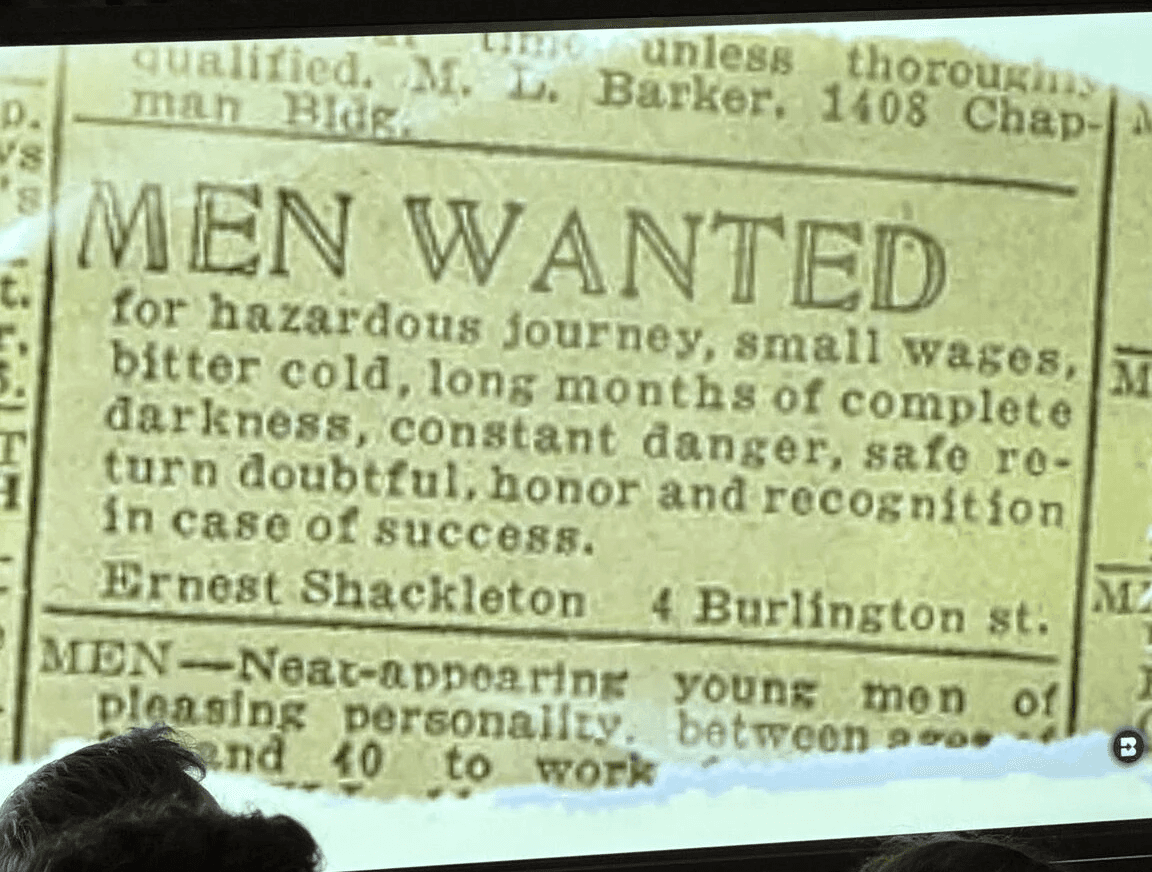
Two crews, one continent, and the decision that determined who came home
On 27 October 1915, Ernest Shackleton stood on pack ice in the Weddell Sea and gave the order to abandon Endurance. Ten million tons of ice had crushed the ship over several days, until there was nothing left of her to save. The mission he had sailed from England to complete, the first crossing of Antarctica on foot, was over before it had properly begun. Twenty eight men were now stranded on drifting ice with three lifeboats, limited rations, no radio, and no realistic prospect of rescue.
Most retellings of what happened next focus on the eighteen months of survival that followed: the camps on the ice, the open boat crossing to Elephant Island, the eight hundred mile voyage to South Georgia in the James Caird, the rescue of every single man in August 1916. It is an extraordinary story, and it earns every word written about it.
But the decision that made all of it possible happened earlier, and it happened fast. It is the decision most leadership retellings skip past on the way to the more dramatic scenes, and it is the one that decides everything else.
Every leader eventually faces a version of Shackleton's moment: a plan that reality has already ended, and a choice about whether to keep defending it or replace it honestly.
Good decision-making under pressure is rarely about courage in isolation. It depends just as much on whether the people acting on a decision can find out when that decision has changed.
The same conditions, extreme pressure, high stakes, a plan overtaken by events, can produce a survival story or a tragedy, and the variable that decides which one it becomes is not always inside the room where the decision is made.
The mission had already failed
Shackleton had a choice about what came next.
He could have kept the crew oriented around rescuing the plan. Waited for a break in the ice. Argued that the expedition could still be salvaged in some reduced form. Protected the version of the story he had promised his sponsors, his backers, and himself before he ever left England. Under far less pressure than a crushed ship on the ice, many leaders do exactly this. They keep defending a plan that reality has already ended, because the plan is bound up with their name, their reputation, and their sense of who they are.
Shackleton did something different, and he did it almost immediately. The object of the expedition changed. Crossing Antarctica became: every man goes home alive. Not as a fallback. As the new mission, held with the same seriousness the original one had.
That distinction runs through every decision that followed. It is why he took an inferior sleeping bag over a better one, so that officers had no advantage over crew. It is why Captain Worsley later described him ordering hot drinks for the whole camp, rather than for one man alone, so that the man suffering worst from the cold was never singled out and frightened by the attention. It is why, on the sixteen-day boat passage to Elephant Island, he changed the route four times as new information came in, rather than holding a course he had already committed to. None of that is a personality trait. It is what a leader does once the real objective of the work has been named honestly and then protected as carefully as the original one was.
There is a version of this story told as pure optimism: Shackleton stayed positive, and positivity saved the crew. That version is incomplete, and it undersells him. Unmanaged optimism, in a situation with genuine and mounting danger, is denial. What Shackleton did was harder than staying positive. He kept the facts of the situation, the cold, the food supply, the odds, fully in view, while refusing to let those facts collapse into despair. Reality without collapse. Hope without pretending the ice wasn't real. That combination, not cheerfulness, held twenty eight men together for two years in conditions that should have broken them.
What was happening, decision by decision
There is a way to look at what Shackleton did that goes beyond character. Four separate decisions sit inside his response to the loss of Endurance, and all four are visible in the record.
The first is what he was committed to. Before the ship was crushed, the stated commitment wasto cross a continent. Once it was crushed, Shackleton didn't simply hope for the best. He stated a new commitment, clearly and immediately: every man returns alive. That single act of naming a new objective, out loud, at the moment the old one died, is what everything else in the story hangs from. A crew cannot be led toward an objective nobody has named.
The second is how he carried himself while making the decisions that followed. He did not defend the old plan out of pride, and he did not collapse into panic once it was gone. He looked at what the ice and the weather and the food supply told him, changed course when the facts changed, and never let the crew see indecision dressed up as calm. That combination, honest about the facts and steady under them, is what allowed four separate changes of route on the way to Elephant Island without any loss of authority. A leader who is still fighting the last plan, orwho is visibly rattled by the new one, cannot make that kind of call in real time.
The third is whether he understood what the people around him needed, individually, not as an abstract crew. The hot drinks ordered for everyone rather than the one man who was struggling.The inferior sleeping bag taken by an officer rather than a rating. The refusal to let hierarchy decide who suffered least. Shackleton read the specific condition of specific men and adjusted for it, rather than managing morale as a single dial turned up or down for the group.
The fourth is whether the mission, once redefined, was carried out with the same discipline as the original one, or simply declared and left to chance. It was carried out. Rationing, watch rotations, the discipline of the march to the boats, the refusal to let good behaviour slip once the immediate danger passed. The new mission was executed with as much rigour as the old one, which is the part most retellings leave out entirely in favour of the more dramatic rescue scenes.
Put together, those four things, a stated objective, a steady posture under pressure, close attention to the people affected, and disciplined follow-through, are what took Shackleton from afailed expedition to a completed rescue. Remove any one of them and the story plausibly ends differently. A stated objective without steady posture becomes bravado. Steady posture without attention to the crew becomes cold competence that nobody trusts. Attention to the crew withoutdisciplined follow-through becomes good intentions that don't survive contact with a second crisis.
These four things deserve to be named properly, because they recur in every account of good decision-making under pressure, not just this one. The Decision Clarity Cycle describes them asStrategic Conviction (what you are committed to, stated plainly), Decision Posture (how you hold yourself while the decision is being made, honest about the facts, steady rather than defensive or panicked), Stakeholder Reality (what the specific people affected by the decision need, rather than what a general instinct to "keep morale up" assumes they need), and Execution Integrity (whether the decision, once made, is carried through with the same discipline it was announced with). Shackleton's response to the loss of Endurance is a clean, complete example of all four operating together. It is also, usefully, a continuous loop rather than a single event: what he learned about his crew's condition during the ice camps fed directlyinto how he set the new Strategic Conviction for the boat passage, which is why the route to Elephant Island changed four times without ever losing the crew's trust.
The other side of the continent
While Shackleton was making that decision in the Weddell Sea, a second crew was at work a thousand miles away, and their story rarely gets told alongside his, because it doesn't end the same way.
The Imperial Trans-Antarctic Expedition had two halves. Shackleton's party was meant to cross the continent on foot. A support party, the Ross Sea party, was meant to sail into McMurdo Sound aboard the Aurora, land on the far side of Antarctica, and lay a chain of supply depots across the Ross Ice Shelf, so that Shackleton's crew would have food and fuel waiting for them on the final leg of a crossing nobody on the Ross Sea side would ever see happen.
The Ross Sea party was led by Aeneas Mackintosh. Partway through the depot-laying work, a storm tore Aurora from her moorings and carried her out to sea for months, leaving the shore party without their ship, without fresh supplies, and without any way of learning what had happened to Endurance on the far side of the continent.
They kept laying depots anyway. It was the job they had been given, and as far as they knew, it still mattered.
Spencer-Smith, the expedition's chaplain and photographer, was weakened by scurvy until he could no longer walk, and was being hauled back toward base on a sledge when he died in March 1916. Mackintosh and a companion, Hayward, were lost two months later, walking across sea ice that gave way beneath them in a blizzard, still working to finish the obligations of an expedition whose other half had already failed.
By the time those three men died, Shackleton's crossing had already been abandoned for months. The depots the Ross Sea party gave their lives to lay were never used for the purpose they were laid for, because the crossing they were meant to support never took place.
The same four decisions, and where they broke
Run the same four decisions against Mackintosh's crew, and the picture is not one of failure through weak character. It is closer to the opposite.
Their commitment to the task was never in question, and if anything it held too firm for too long, because nothing ever arrived to tell them it should change. Their conduct under pressure, judged on its own terms, matches Shackleton's for discipline and resolve; men do not walk out onto sea ice in a blizzard to finish a job out of carelessness. What they did for each other, sharing rations, covering for Spencer-Smith as his strength failed, shows the same attention to the person in front of them that marks Shackleton's leadership. And their follow-through was, if anything, excessive. They executed the plan they had been given with total commitment, right up to the point where the cost of executing it killed them.
What broke was none of the four elements of the cycle directly. Mackintosh's Strategic Conviction was clear and consistently held. His Decision Posture, judged on the facts he had, was steady rather than reckless. His attention to Stakeholder Reality, the men immediately around him, held up under strain right to the end. His Execution Integrity was, if anything, total. What broke was the connection between all of that and the wider picture. Aurora going adrift didn't just cost the shore party a ship. It cost them the one channel through which a change in reality, the loss of Endurance, the collapse of the crossing, the fact that their depots no longer served any purpose, could have reached them and reset their Strategic Conviction. Shackleton could redefine his mission because he stood in the middle of the event and saw it happen. Mackintosh's crew never got that chance. Their mission stayed fixed not because they lacked the judgement to change it, but because nobody with the updated picture of reality had any way of telling them the picture had changed.
That is the harder half of the lesson, and the reason this case belongs beside the rescue story rather than as a footnote to it. Good judgement under pressure is necessary. It is not sufficient on its own. It only produces a survival story if the people holding that judgement also have a livechannel back to whoever is acting on their decisions, and forward to whoever needs to know when those decisions have changed.
What was learned, and what wasn't
What the Weddell Sea side of the story shows clearly: a leader who names the real mission the moment the old one dies, stays honest about the facts without collapsing under them, reads the specific needs of the people in front of him, and follows through with full discipline, can turn a failed expedition into a complete rescue.
What the Ross Sea side of the story shows just as clearly, and what the standard version of thisstory tends to leave out: the same qualities, applied with equal seriousness, are not enough on their own if the connection between the decision and the people carrying it out has already beensevered. Mackintosh's crew were not undone by a failure of character or resolve. They were undone by an information gap nobody on either side of the continent had the means to close.
What the historical record does not resolve, and what no amount of retelling can supply, is whether an earlier or more resilient link back to the Ross Sea party could have reached them in time. The storm that took Aurora was outside anyone's control. What is within a leader's control, in a business rather than on an ice shelf, is whether that kind of gap is treated as a foreseeable risk to be designed against, or as bad luck to be regretted only after it has already cost something.
How this carries forward
Treat "who doesn't yet know the plan has changed" as a standing question during any crisis, notan afterthought raised once the damage is visible.
When a plan fails downstream, look first at whether the failure sat in judgement or in whether the update ever had a route to reach the people executing it.
Build a deliberate way of checking whether the plan a team is executing today still matches what leadership currently knows to be true, rather than assuming the two are still the same.
Close
Two ships set out from England as one expedition. Both crews faced the same continent, the same cold, and the same collapse of the plan that had brought them there. Only one of them had a way of finding out that the story had already changed.
If a plan inside your organisation might already be running on information that's gone stale somewhere between the decision-makers and the people carrying it out, look at that properly rather than assuming it away.


